Mid-size medical device companies face a product development challenge that is putting them at a serious competitive disadvantage compared to the largest life sciences corporations. The challenge is that you have a strong product pipeline, a clear regulatory pathway, and commercial pressure to move fast, but your internal development team is at capacity.
Your ideas are promising, and the technical hurdles can be overcome. However, the product development program in your organization still stalls because of resourcing realities, i.e., difficulties in recruiting and retaining skilled project managers and design engineers.
Importantly, this situation is not a failure at the organizational level. Instead, it is an industry-wide challenge that the big corporates use their deep pockets and extensive footprints to overcome.
For medium-sized MedTech companies, you need other options. We will explore those options in this blog.
Table of Contents
Why Development Bottlenecks Hit Mid-Size MedTech Companies Hardest
A European football (soccer) analogy works well as a comparison. Football teams in Europe compete in multiple competitions across a season, including their domestic leagues, domestic cup competitions, and Europe-wide cup competitions. As a result, teams play competitive matches twice a week for large parts of the season.
It’s not surprising, then, that the biggest and richest football clubs are the most successful, as they have greater resources. This can be described as bench strength, i.e., they have enough high-quality players in their squad that they can remain competitive in a busy schedule.
The big corporations in the life sciences sector have this as well – bench strength. In other words, they have enough skilled resources across all necessary disciplines to power through complex and highly regulated development programs.
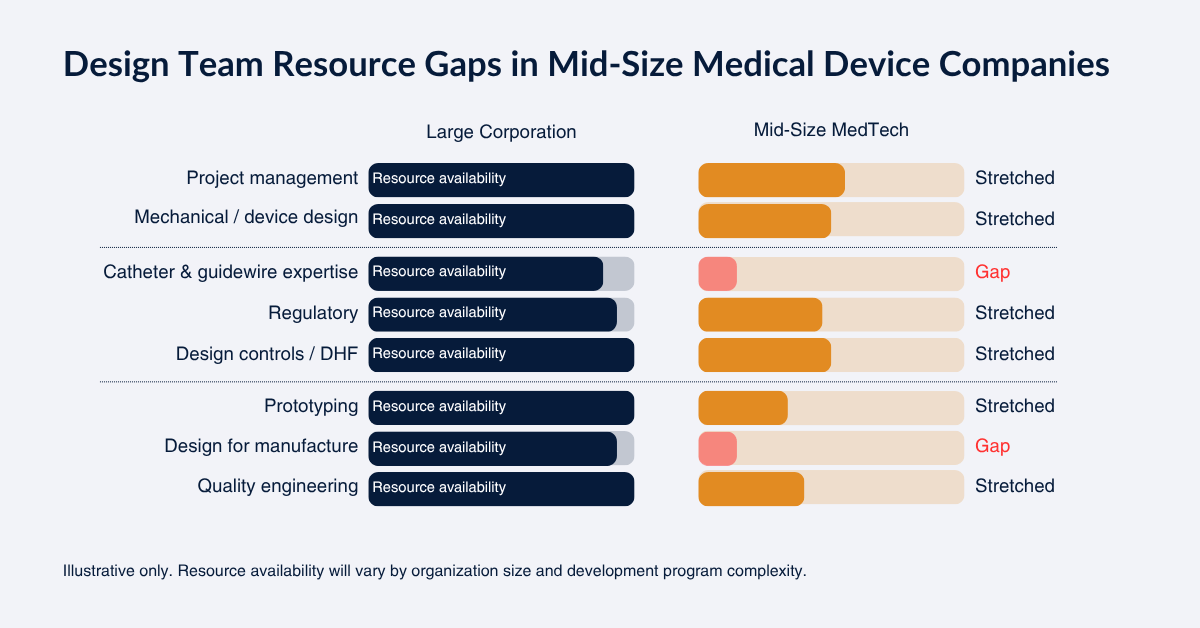
As a medium-sized medical device company, you are probably large enough to also have a complex, regulated development program, but not the bench strength needed to deliver it.
Specialist Skills
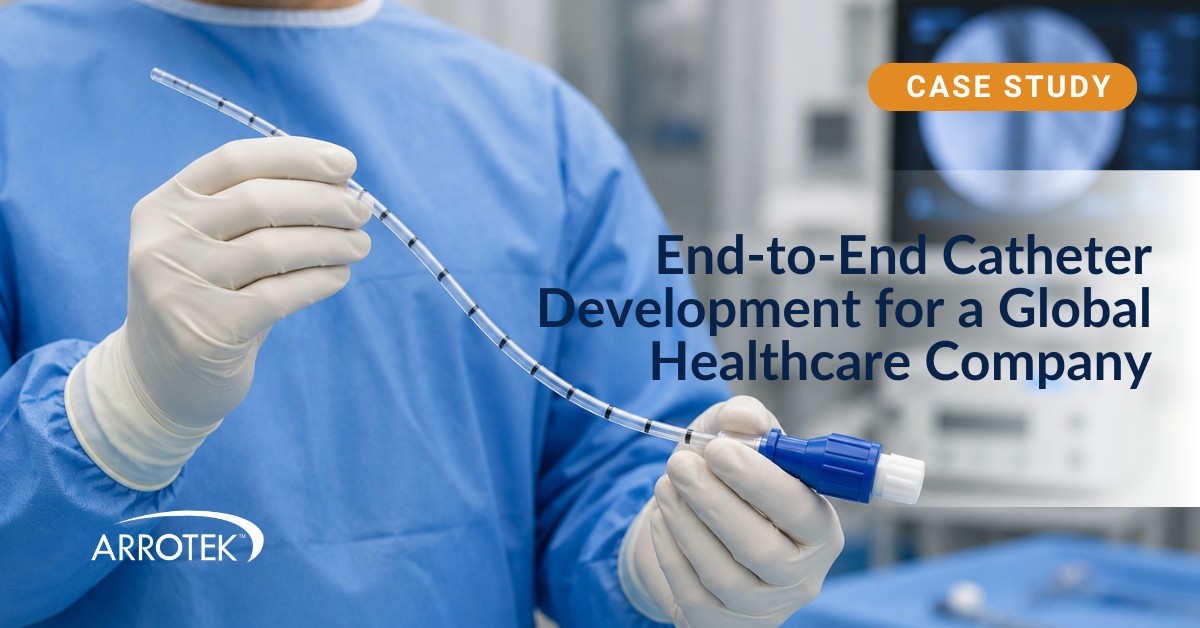
The need for specialist skills can also be an issue, whether you have sufficient bench strength or not. For example, part of your development program might be the design of a highly complex catheter for a delivery system. Given the nature of complex catheter design, this is the sort of program that can suffer delays if you don’t have specialists on your team.
Competing Priorities
Another area worth highlighting is the competing priorities of sustaining existing products and developing new ones. How do you divide up your limited resources to maintain and grow the market position of existing products while opening up new markets with the development of new products?
Decision Lag
Decision lag is an issue, too. On the product development front, project timelines are ideally fast. Headcount decisions, on the other hand, take time, so they regularly lag behind what is needed to deliver the development program. That’s before you even take into account recruitment timelines, which are usually measured in months.
The Cost of Doing Nothing – Or Doing it Slowly
The MedTech product development resource challenges described above can lead to programs being delayed or progressing much more slowly than they could be if properly resourced. But this has a cost. A cost that is often underestimated.
Therefore, it’s worth looking at what happens if product development bottlenecks are left unresolved:
- Competitive risk – your competitors can move faster, especially if they are larger corporations. This can put you at a competitive disadvantage that can be difficult to recover from.
- Regulatory risk – once programs do start, they are sometimes put on accelerated timelines in an attempt to catch up. This can lead to issues such as design shortcuts that can produce a range of downstream problems, including increased regulatory risks.
- Team burnout – product development bottlenecks can put additional pressure on your existing team members, leading to burnout and attrition.
- Delayed market entry – this has a direct commercial impact, but delayed market entry also has knock-on impacts across the full product lifecycle.
In summary, doing something about product development bottlenecks has a cost. But doing nothing is not a cost-free choice, as it also has expensive implications.
Rethinking the Medical Device Product Development Resourcing Model
The question then comes down to, how do you overcome product development bottlenecks?
The traditional approach is to launch a recruitment campaign to hire the resources you need. If you’re lucky, new starts will walk through the door in about three months. If your luck remains, they will still be in place a month or two later once you get through the onboarding process. You will then be in a position, several months in with a good dollop of luck along the way, to start ramping up product development.
There is an alternative, though. It is a more flexible resourcing model that involves external design partners.
Working with external design partners offers a range of advantages:
- An external design partner will hit the ground running, enabling you to immediately ramp up your product development programs.
- The structure of the engagement can be tailored to your needs. For example, you can get access to specialist skills to augment your existing team, or the external partner can take on the entire project.
- You remain in control. For example, you can choose where to place the boundary, i.e., what elements to keep in-house and what can be delegated to an external partner.
- Scaling is fast and flexible, so you can quickly adjust according to business needs and your development program.
What to Look for in a Medical Device Design and Development Partner
Medical device design and development experience should be the starting point, as generalist engineering contractors won’t have the regulatory knowledge that is essential in MedTech projects.
Specialist medical device expertise is also beneficial. For example, if you are developing a novel catheter, it makes sense to partner with a company that has a proven track record in catheter device design.
Other important considerations include:
- Ability of the medical device design partner to integrate seamlessly with your in-house team to ensure the project runs efficiently.
- Design for manufacturing expertise, as there is a big difference between a medical device prototype and a manufacturable medical device prototype.
- Confidentiality and intellectual property, as your IP should be ringfenced and protected.
Making the Case Internally
At Arrotek, we often work with R&D and engineering managers who know external support is necessary but who have to then build an internal business case.
Some tips for building an internal business case include:
- Quantify the costs not just of engaging the external partner, but also the cost of delay or stagnation.
- Present the solution as accelerating a capital investment that has already been committed to, i.e., the product development program.
- Position the solution as a risk management decision given the market, commercial, and cost risks created by development bottlenecks.
The Right Expertise, at the Right Time
Engaging an external medical device design and development partner enables you to move your product development program at the same speed as your pipeline, while retaining maximum flexibility.
Flexibility is a crucial component, as success in product development doesn’t come from an expanding headcount. In fact, the strongest design teams are not always the biggest. Instead, they are those who have access to the right expertise and resources at the right time.
This is an area where we operate at Arrotek. Whether taking on a defined workstream end-to-end or assigning specialist engineers for specific tasks, our engagement model flexes to adapt to the product development programs of our clients, not the other way around. Get in touch to learn more.