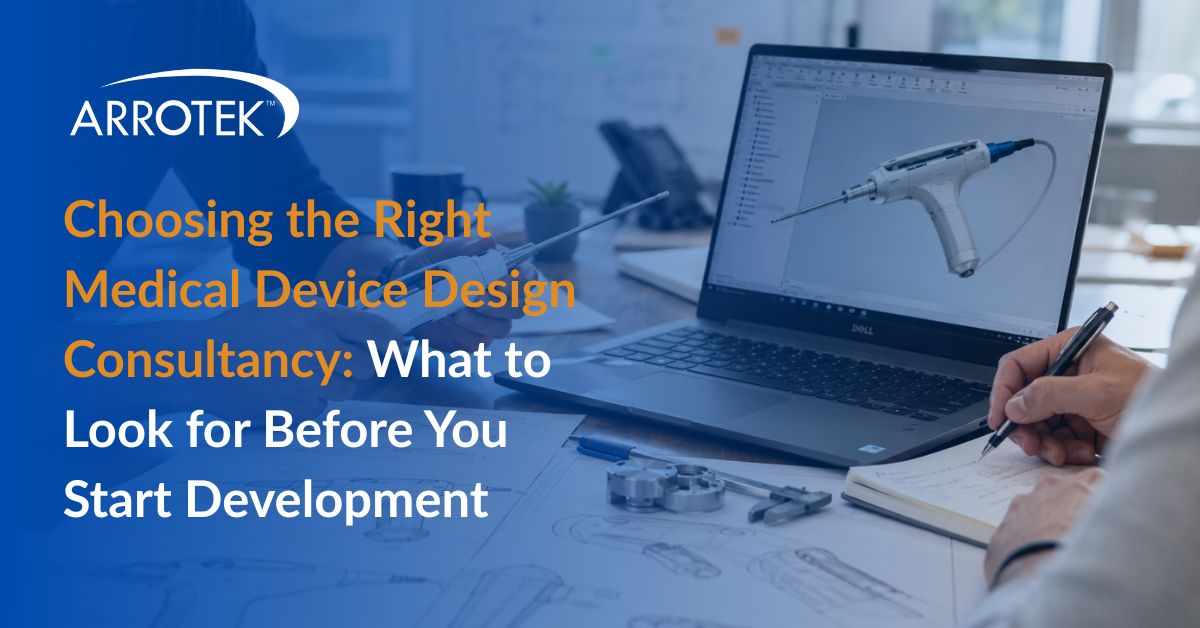
Bringing a new medical device from concept to market is a complex journey. Choosing the right medical device design consultancy can significantly influence the speed of development, regulatory success, manufacturing readiness, and ultimately, the commercial success of your product.
Whether you’re a MedTech startup developing your first device or an established OEM expanding your portfolio, selecting the right development partner is one of the most important decisions you’ll make.
In this guide, we explore the key factors to consider when evaluating a medical device design consultancy, helping you make an informed decision that reduces risk and accelerates innovation.
Why Your Choice of Design Partner Matters
Medical device development is about much more than creating a functional prototype. Successful products require expertise across multiple disciplines including:
- Clinical needs assessment
- Human factors engineering
- Mechanical and electronic design
- Materials selection
- Risk management
- Verification and validation
- Regulatory compliance
- Design for Manufacturability (DFM)
- Manufacturing transfer
A consultancy that understands the complete product lifecycle can help identify potential challenges early, reducing costly redesigns later in the development process.
Industry Experience in Medical Device Development
Not all engineering consultancies are experienced in regulated healthcare products.
Look for a partner with proven expertise in medical device development, particularly within your therapeutic area or device category.
Ask questions such as:
- Have they developed similar devices?
- Do they understand minimally invasive technologies?
- Can they demonstrate successful commercial projects?
- Do they have experience with startups as well as multinational manufacturers?
Relevant experience often translates into faster problem-solving and fewer development risks.
Cross-Functional Engineering Expertise
Innovative devices rarely rely on a single engineering discipline.
An effective medical device design consultancy should offer multidisciplinary expertise either in-house or through a network of trusted, qualified partners, including:
- Mechanical engineering
- Industrial design
- Electronics
- Software integration
- Materials engineering
- Manufacturing engineering
- Human factors engineering
Having these capabilities under one roof encourages collaboration, shortens development timelines, and reduces communication gaps between teams.
Strong Prototyping Capabilities
Rapid prototyping allows teams to evaluate designs early, gather user feedback, and validate concepts before committing to expensive tooling.
Ask potential partners about their capabilities for:
- Rapid concept development
- Functional prototypes
- Bench testing
- Iterative design improvements
- Design verification support
Fast, high-quality prototyping enables quicker learning cycles and reduces development risk.
Regulatory Compliance from Day One
One of the biggest mistakes companies make is treating regulatory requirements as something to address later.
Experienced consultancies build regulatory compliance into every stage of development.
This includes:
- Design controls
- Risk management
- Usability engineering
- Design history documentation
- Verification planning
- Standards compliance
Designing with regulatory expectations in mind can help avoid costly redesigns and simplify future submissions.
Design for Manufacturability (DFM)
A brilliant concept can still fail if it cannot be manufactured efficiently.
Your development partner should consider manufacturing requirements from the earliest design stages by focusing on:
- Material selection
- Component sourcing
- Process optimisation
- Assembly efficiency
- Cost reduction
- Scalability
Early Design for Manufacturability reduces production costs and improves long-term product reliability.
Technology Transfer and Manufacturing Support
Many consultancies stop once the design is complete.
However, successful commercialisation depends on a smooth transition into manufacturing.
Look for a partner that supports:
- Pilot production
- Process validation
- Manufacturing documentation
- Supplier collaboration
- Production transfer
- Ongoing engineering support
A seamless handoff reduces delays and helps ensure products perform consistently in production.
Communication and Project Management
Medical device projects involve numerous stakeholders, changing requirements, and strict timelines.
Choose a consultancy that provides:
- Regular project updates
- Clear milestones
- Transparent budgeting
- Dedicated project management
- Collaborative decision-making
Strong communication keeps projects moving efficiently while reducing misunderstandings.
Questions to Ask During Your Product Design Evaluation
Before selecting a partner, consider asking:
- Can you show examples of similar projects?
- What regulatory standards do you routinely work to?
- How do you approach risk management?
- What prototyping capabilities do you offer?
- How do you manage design changes?
- What manufacturing support is available after development?
- How do you ensure knowledge transfer into production?
These questions can provide valuable insight into a consultancy’s experience and working practices.
Why End-to-End Development Matters
Many companies engage separate suppliers for design, prototyping, manufacturing engineering, and production.
While this approach can work, it often introduces additional complexity, communication challenges, and delays.
Working with an end-to-end development partner can provide:
- Better continuity throughout the project
- Faster decision-making
- Reduced development risk
- Improved design consistency
- Earlier manufacturing planning
- More efficient commercialisation
This integrated approach is particularly valuable for innovative and complex medical devices.
How Arrotek Supports Medical Device Innovation
At Arrotek, we support companies throughout the entire medical device development journey—from early concept generation and feasibility through to prototyping, design verification, manufacturing transfer, and commercial production.
Our multidisciplinary engineering teams work across a broad range of minimally invasive technologies, helping customers develop innovative healthcare products while keeping manufacturability, usability, and regulatory expectations at the forefront of every project.
By combining design expertise with manufacturing knowledge, we help reduce development risk, accelerate timelines, and create products that are ready for successful commercialisation.
Choosing the Right Medical Device Design Consultancy
Selecting a medical device design consultancy is about more than technical capability. The right partner should understand your clinical objectives, regulatory pathway, manufacturing strategy, and commercial goals.
By evaluating experience, engineering expertise, regulatory knowledge, prototyping capabilities, and manufacturing support, you can choose a partner that adds value throughout every stage of development—not just during product design.
If you’re planning your next medical device project, investing time in selecting the right development partner can be one of the most important decisions you make.
Ready to Develop Your Next Medical Device?
Whether you’re refining an early-stage concept or preparing for manufacturing, Arrotek provides integrated engineering, prototyping, regulatory-focused development, and manufacturing support to help bring innovative medical devices to market with confidence.
Talk to our team today to discuss your next project.
Email: [email protected]