Sourcing precision medical needles and similar components from Asian-based manufacturers has been the default position for years. The lower prices you often get in that part of the world simplified the supplier evaluation calculation, making decisions straightforward.
But the supplier evaluation calculation has changed. The decisions are no longer as straightforward. This is leading many medical device OEMs to explore alternative options. Nearshoring to the Americas is one of the options that increasingly makes sense.
Whether nearshoring is right for your organisation depends on a number of factors, including the production volumes you need, reducing supply chain risk, and current operational conditions. Tariffs and shipping realities are also factors.
What is the Impact of Tariffs and Shipping?
Tariffs are always a consideration, and the situation can change quickly. Take two examples: China and Costa Rica. At the time of writing, tariffs on medical needles manufactured in China are subject to a Section 301 duty of 100%. Costa Rica, on the other hand, is part of a regional free trade agreement with the US known as CAFTA-DR. That agreement covers most medical device components.
On shipping, the simple answer is to say Costa Rica is better because it is closer. The reality is a bit more nuanced, particularly when goods are sent by sea, as sailing frequencies are much higher from China. What Costa Rica does offer is viable shipping alternatives by truck and air, which can reduce shipping times to as little as one or two days.
Does Nearshoring Reduce Supply Chain Risk?
Nearshoring to a medical needle manufacturing partner in a location like Costa Rica doesn’t remove supply chain risk. That is not realistic. What it does, however, is change the shape of that risk.
For example, it is generally accepted that nearshoring to Costa Rica reduces your exposure to tariff shifts. Also, because you have alternative shipping options, risks from situations such as port congestion are also reduced.
But there are other supply chain risks, such as quality and compliance, that remain broadly the same whether you source your medical needles from a manufacturer in Asia or the Americas.
All of this highlights the importance of undertaking a structured evaluation of medical needle suppliers. That evaluation should go beyond regional assumptions and unit prices.
An Evaluation Toolkit Using Your Numbers
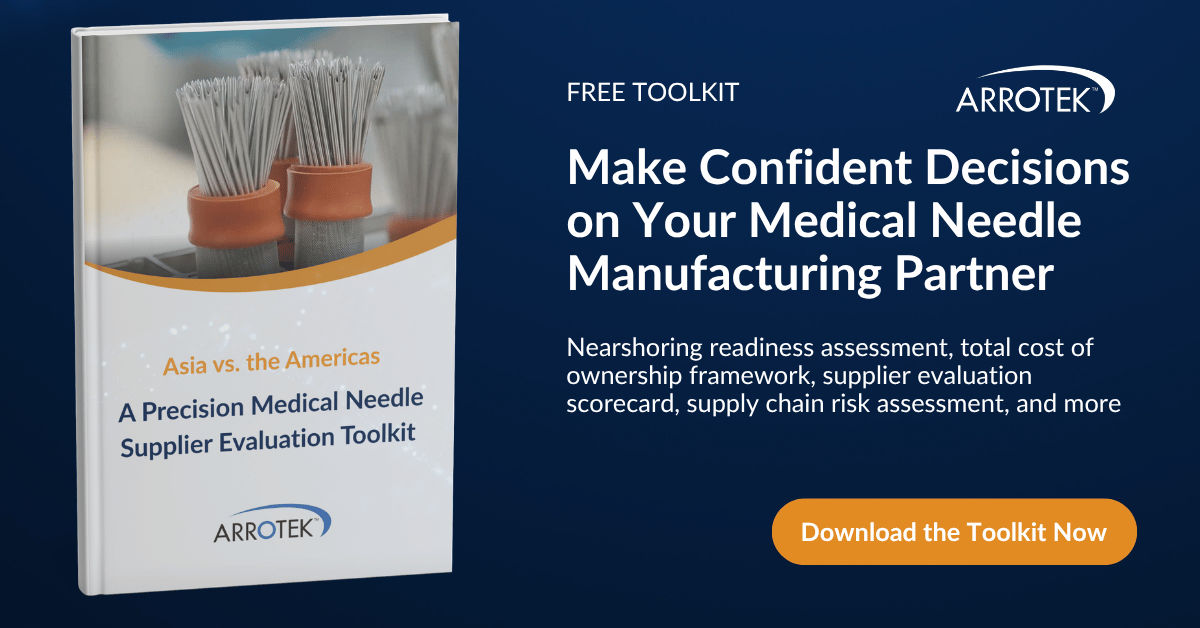
Arrotek built the Asia vs. the Americas: A Precision Medical Needle Supplier Evaluation Toolkit to help sourcing, supply chain, and quality teams make decisions based on evidence. It includes:
- Nearshoring Readiness Assessment – 14 considerations to assess whether nearshoring is something you should be exploring.
- Total Cost of Ownership Framework – seven cost categories beyond unit price, with an Excel calculator.
- Supplier Evaluation Scorecard – 20 criteria across five weighted pillars.
- Supply Chain Risk Assessment – a heat map showing the likelihood and impact of the most pressing supply chain risks.
- Regulatory and Tariff Exposure Snapshot – explanations of the position at the time of writing with links to official sources for checking current rates.
- Lead Time and Logistics Comparison – five shipping options broken down stage by stage.
- Supplier Qualification Checklist – covering pre-audit, audit, and pilot run stages, as well as red flags to watch for.
- Weighted Decision Matrix – a tool that combines quality, cost, and risk factors into a single score.
- Summary and Recommendation Template – a template that can be used in an internal email or added to a deck.
Each tool in the toolkit is standalone. The best place to start is the readiness assessment, especially if you’re unsure whether this is worth your time. If you already know it is important for your organisation, jump to the total cost of ownership framework.
Download the toolkit
Fill in the form below to get the 24-page PDF toolkit and the Excel workbook.
Arrotek manufactures precision needles at its Costa Rica facility. If your results point towards an exploration of Costa Rica sourcing, we would welcome a conversation.