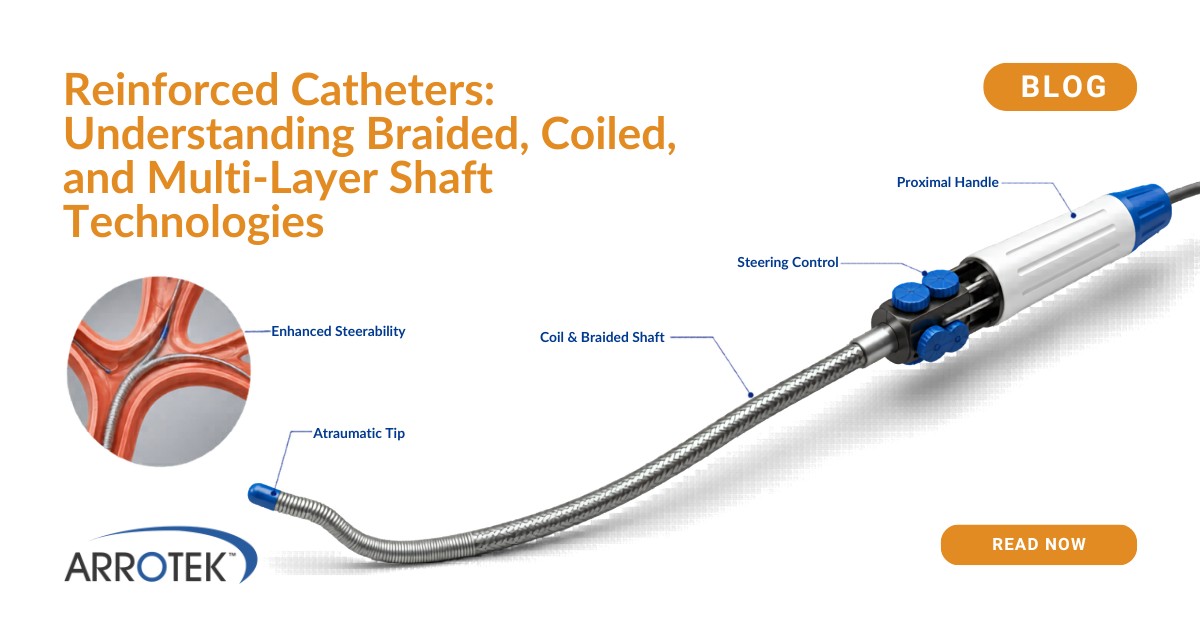
As minimally invasive procedures continue to evolve, catheter design has become increasingly complex. Devices are expected to navigate smaller vessels, tighter anatomical curves, and more demanding access pathways, all while maintaining precise control and reliability.
Whether in cardiovascular, neurovascular, electrophysiology, or structural heart applications, catheter shaft performance plays a critical role in procedural success. Engineers are continually balancing competing mechanical requirements such as flexibility, pushability, torque transmission, profile reduction, and kink resistance.
This is where reinforced catheter shaft design becomes essential.
Why Reinforcement Matters in Catheter Design
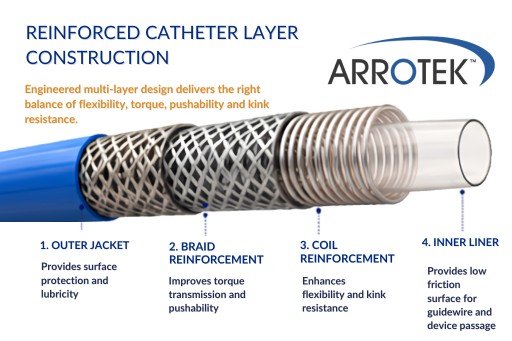
A standard polymer tube alone is often unable to provide the mechanical performance required for advanced interventional procedures. Reinforcement structures embedded within the catheter wall help tailor the shaft’s behaviour for specific clinical applications.
The challenge is that no single reinforcement strategy solves every problem.
A shaft optimised for torque response may sacrifice flexibility. A highly flexible shaft may lose pushability or become prone to kinking. Reinforcement design is therefore about balancing trade-offs rather than maximising a single characteristic.
Modern catheter shafts are typically engineered using one or more reinforcement approaches, including:
- Braided reinforcement
- Coiled reinforcement
- Hybrid braid-to-coil transitions
- Multi-durometer polymer constructions
- Multi-lumen architectures
Each configuration influences how the catheter behaves during navigation through complex anatomy.
Braided Catheter Shafts and Torque Transmission
Braided shafts use woven reinforcement embedded within the catheter wall, commonly using stainless steel or nitinol wire.
Braiding is often selected when torque response and shaft support are priorities. The braided structure allows rotational force applied proximally to transfer efficiently to the distal end of the device, improving steerability and procedural control.
Braided shafts are commonly used in applications where:
- Controlled navigation is required
- Device positioning accuracy is critical
- Long vascular pathways must be traversed
- Pushability and shaft stability are important
However, braid design introduces important engineering considerations.
Increasing braid density or wire stiffness may improve torque transmission and burst resistance, but it can also reduce flexibility. Conversely, lower braid density may improve flexibility while reducing support.
Several braid variables influence final shaft performance, including:
- Wire diameter
- Flat, round, or ribbon wire geometry
- Number of carriers
- Braid angle
- Pick count
- Material selection
Even small adjustments to braid configuration can significantly alter shaft behaviour.
Coiled Catheter Shafts and Kink Resistance
Coiled reinforcement provides a different set of mechanical advantages.
A coiled shaft uses helically wound wire embedded within or around the catheter structure. Coil reinforcement is often preferred when flexibility and kink resistance are critical requirements.
Unlike braided structures, coiled reinforcement allows the shaft to bend more naturally while maintaining lumen integrity. This becomes particularly important in tortuous anatomy where excessive bending can collapse unsupported tubing.
Coiled shafts are commonly selected for:
- Distal shaft sections
- Highly tortuous anatomy
- Atraumatic navigation
- Flexible access devices
- Steerable catheter systems
Coil design itself can vary significantly depending on the intended application.
Key variables include:
- Flat or round wire profiles
- Coil pitch
- Wire stiffness
- Coil diameter
- Material selection
- Variable pitch transitions
Flat-wire coil constructions are increasingly used where low-profile designs and smoother flex characteristics are required.
Hybrid Braid-to-Coil Reinforcement
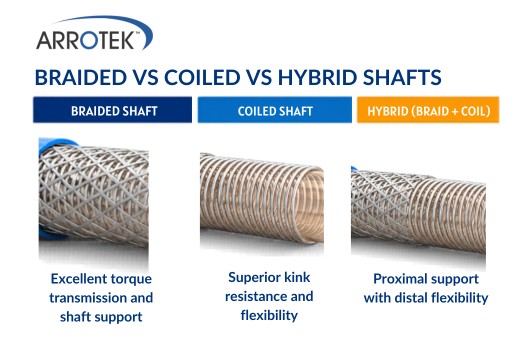
Many modern catheter systems no longer rely solely on either braid or coil reinforcement. Instead, engineers increasingly combine both structures within a single shaft.
Hybrid braid-to-coil constructions allow different regions of the catheter to perform different functions.
For example:
- A braided proximal shaft can provide pushability and torque control
- A coiled distal section can improve flexibility and reduce trauma risk
This transition between reinforcement types helps create a more controlled stiffness profile along the shaft length.
Hybrid reinforcement strategies are becoming increasingly common in:
- Steerable delivery systems
- Neurovascular catheters
- Structural heart devices
- Electrophysiology systems
- Large-bore access devices
As procedures become more complex, the ability to engineer localised shaft performance becomes increasingly important.
The Role of Multi-Durometer Shaft Design
Reinforcement alone is only one aspect of catheter shaft optimisation.
Polymer durometer, the hardness or stiffness of the catheter jacket material also plays a major role in overall device behaviour.
Multi-durometer shafts use varying polymer stiffness along the catheter length to create more gradual transitions between rigid and flexible sections.
Typically:
- Softer distal materials improve flexibility and atraumatic navigation
- Stiffer proximal materials improve support and pushability
Combining reinforcement strategies with multi-durometer constructions allows engineers to fine-tune shaft performance with much greater precision.
This is particularly important in devices requiring:
- Complex navigation
- Stable positioning
- Tight bend performance
- Reduced vessel trauma
Multi-Lumen and Functional Integration
Modern catheter systems increasingly integrate multiple functions within a single shaft.
Multi-lumen constructions can accommodate:
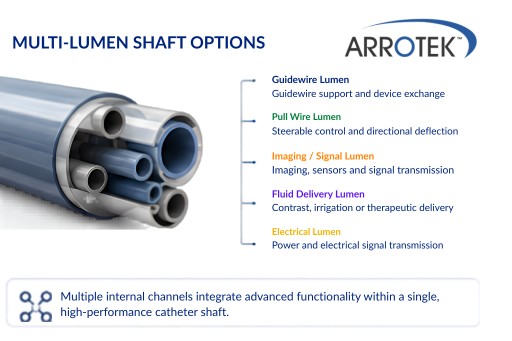
- Guidewires
- Pull wires
- Imaging systems
- Fluid delivery
- Electrical conductors
- Sensor integration
As devices become smaller and more multifunctional, maintaining shaft performance while integrating additional components becomes a significant engineering challenge.
This has driven increased demand for:
- Thin-wall constructions
- Advanced liner materials
- Precision reinforcement placement
- Complex extrusion technologies
Manufacturing Challenges in Reinforced Catheters
Designing reinforced catheter shafts is only part of the challenge. Manufacturing consistency is equally critical.
Processes such as braiding, coiling, reflow, tipping, and reinforcement termination require tight process control to maintain dimensional accuracy and mechanical consistency.
Variability in:
- braid tension
- coil pitch
- polymer flow
- thermal processing
- or reinforcement transitions
can significantly impact catheter performance.
Additional manufacturing considerations include:
- smooth reinforcement termination
- atraumatic distal tip formation
- liner integrity
- wall thickness control
- and mandrel removal processes
As catheter walls continue to become thinner, manufacturing tolerances become increasingly demanding.
Material Selection and Performance
Material selection also has a major influence on reinforced catheter behaviour.
Common reinforcement materials include:
- Stainless steel
- Nitinol
- Aramid fibres
- Fabric-based reinforcements
Meanwhile, liner and jacket materials may include:
- PTFE
- FEP
- PEBA
- Polyamide
- Polyurethane
- PEEK
- Polyimide
Each material introduces different characteristics related to:
- lubricity
- flexibility
- thermal stability
- bondability
- and chemical resistance
Selecting the right combination often depends on both the clinical application and the manufacturing process itself.
Emerging Trends in Reinforced Catheter Design
Several trends are currently shaping the future of reinforced catheter development.
Device Miniaturisation
Smaller access profiles continue to drive demand for thinner wall constructions without sacrificing mechanical performance.
Increased Steerability
Complex anatomy and robotic-assisted procedures are increasing demand for highly steerable shaft architectures.
Hybrid Reinforcement Structures
More devices are incorporating localised reinforcement strategies tailored to specific shaft sections.
Integrated Imaging and Electrical Functionality
Advanced therapeutic and diagnostic devices increasingly require integrated electrical transmission, imaging, and sensing capabilities within flexible catheter platforms.
Advanced Simulation and Modelling
Simulation tools are playing a larger role in predicting catheter behaviour before physical prototyping, helping accelerate development and optimise performance earlier in the design cycle.
Reinforced Catheter Development Continues to Evolve
Reinforced catheter shaft design is fundamentally an exercise in balancing competing performance characteristics.
Achieving the right combination of flexibility, torque response, pushability, and kink resistance requires careful consideration of reinforcement geometry, materials, shaft architecture, and manufacturing processes.
As minimally invasive procedures continue to advance, reinforced catheter technologies will remain central to enabling more precise, reliable, and less traumatic device navigation.
At Arrotek Medical, we work with medical device start ups, OEMs and medical device partners on the development and manufacture of reinforced catheter technologies across a wide range of minimally invasive applications, supporting projects from early-stage development through to manufacturing scale-up.
If you would like to get in touch fill out the form below or email us directly on [email protected]